|
|
| What is SPL? |
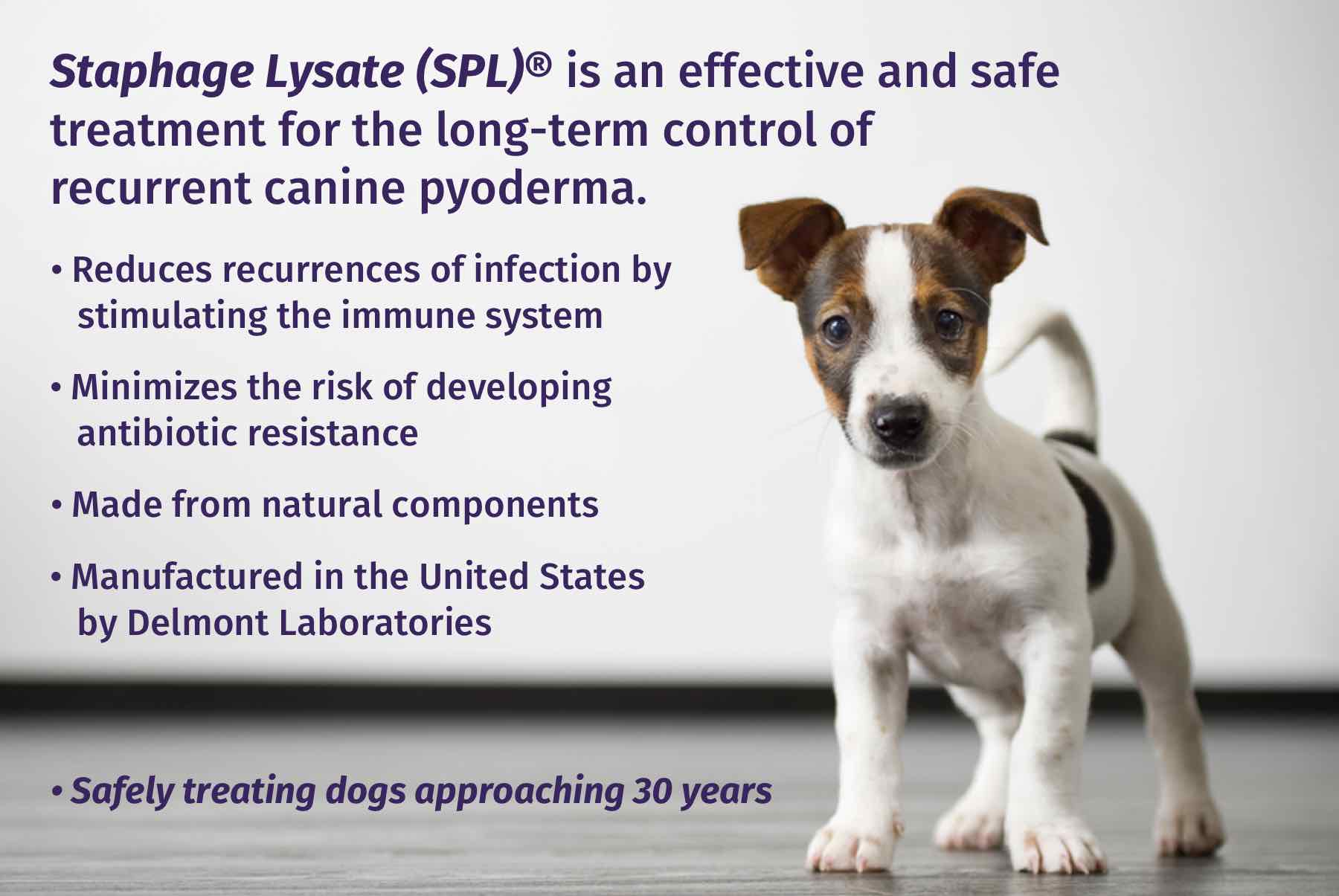
SPL® is a highly effective bacterial antigen licensed for the treatment of idiopathic canine pyoderma. It is the only staphylococcal product of its kind approved for canine use. |
| What is the efficacy rate? |
Our double blinded study demonstrated a 77% efficacy rate in pyoderma caused by Staphylococcus intermedius. |
| How can I predict if SPL therapy will be successful? |
The most important predictor of successful SPL therapy is the selection of appropriate cases.
- The dog should have a history of recurrent, idiopathic pyoderma.
- Its disease should be responsive to antibiotics.
- All underlying causes should be ruled out (i.e., demodicosis, flea allergy dermatitis, food allergy and hypothyroidism).
|
|
|
| What technical support is provided? |
Our technical staff will answer any question and assist you to resolve any problem cases. We have the support of many prominent veterinary dermatologists who are available for consultations. |
|
|
| How is SPL supplied? |
SPL comes in 10 ml multidose rubber stoppered vials and in packages of ten 1 ml break-apart glass ampules. There is no difference in the contents. SPL contains no preservatives. Therefore, sterile technique must be used. |
| How is SPL administered? |
SPL is administered subcutaneously. |
| Vials/ampules needed yearly? |
The combination of initial and maintenance regimens requires an average of 3 vials or 3 packages of ampules per year per dog. |
| What is the treatment protocol? |
Protocol for SPL Treatment of Recurrent Superficial Pyoderma in Dogs (DeBoer; 1996; see ref. 9 below)
1. Treat with an effective oral antibiotic for 6 weeks.
2. At the same time, begin administration of SPL at 0.5 ml, subcutaneously, twice weekly. With proper instruction, owners can easily give these injections at home.
3. After 6 weeks, stop antibiotic administration and continue SPL only. Monitor patient's response over the next few months.
4. Allow a 10 to 14 week trial of SPL. If SPL works in the patient, a beneficial response (lack of relapse, much milder relapse, or much longer time interval to relapse) will be seen within this time. If relapse occurs during the initial SPL trial, it is generally not worthwhile to continue the trial.
5. If a beneficial response is seen, the injection interval can slowly be increased to every 5 days, then to 7 days, to 10 days, and finally to 14 days. This should be accomplished over a 3 to 6-month period. Long-term maintenance treatment varies by patient: some dogs do well with one injection every 2 weeks, whereas others require twice weekly injections.
|
| How long before improvements? |
On a twice weekly regimen, relief of redness, itching, lesions and scratching will be seen within 8 to 10 weeks. Symptom relief may take longer on the weekly regimen. |
| How long is the dog on SPL? |
This depends upon the dog. Many require lifetime treatment to control the pyoderma. |
| What are the benefits of SPL therapy? |
Although lifetime treatment may be necessary to maintain control of the pyoderma, the savings to the owner is significant when compared to the cost of frequent courses of antibiotics. Also, very importantly, repeated antibiotic use can result in antibiotic resistant infection. |
|
|
| What kind of adverse reaction could I see? |
Skin reactions: It is unusual for granulomas to occur at the injection site. If a skin reaction does occur, it would consist of redness and/or itching.
Allergic reactions: It is rare for systemic allergic reactions to occur. Should such a reaction occur, the symptoms could be weakness, vomiting, diarrhea, severe itching, fast breathing, malaise and/or fatigue. |
| Combined with Other Therapies |
|
| Is SPL used with antibiotics? If so, for how long? |
The use of an effective oral antibiotic such as oxacillin is recommended for the first 4 to 6 weeks of treatment. Thereafter, antibiotics are usually not necessary.
However, on occasion, a flare-up of the pyoderma may occur. In that case, the veterinarian may wish to prescribe a short course of antibiotics. |
| Can SPL use be concurrent with corticosteroids? |
SPL is an immunomodulator and stimulates T and B lymphocytes. Concurrent administration of corticosteroids--an immunosuppressant-- would likely decrease the effectiveness of SPL. You should not start the SPL regimen until systemic steroids have been cleared from the dog's system. |
| Cost - Delivery - Storage |
|
| What does it cost? | Contact Delmont or your local distributor. |
| Is it returnable? | No. Because there is no minimum order required, SPL is neither returnable nor exchangeable. |
| Does it have an expiration date? | Yes. The average expiration date is one year from time of shipment. |
| How is SPL shipped? | Delmont ships SPL by UPS in the U.S. Shipping time is usually 2 days, a maximum of 4 days, depending upon customer location and date of shipment. |
| How is it stored? | SPL should be refrigerated upon arrival. |
| Selected Bibliography and References |
|
|
1. DeBoer DJ, Moriello KA, Thomas CB, Schultz KT. Evaluation of a commercial staphylococcal bacterin for management of idiopathic recurrent superficial pyoderma in dogs. Am J Vet Res 1990; 51(4): 636-9.
2. Halliwell REW, German NT. Veterinary clinical immunology. Philadelphia: Saunders, 1989: 505.
3. Muller GH, Kirk RW, Scott DW. Small animal dermatology. 4th ed. Philadelphia: Saunders, 1989, 185-6.
4. Rosenkrantz W. Immunomodulating drugs in dermatology. In: Kirk RW, ed: Current veterinary therapy X: small animal practice. Philadelphia: Saunders, 1989: 575.
5. DeBoer DJ. Canine staphylococcal pyoderma-new knowledge and therapeutic advances. Vet Med Rpt 1990; 2(3)1 254-66.
6. DeBoer DJ. Strategies for management of recurrent pyoderma in dogs. Vet Clin N Am: Small Anim Prac 1990; 20(6): 1509-24.
7. DeBoer DJ, Schultz KT, Thomas CB, Moriello KA. Clinical and immunological responses of dogs with recurrent pyoderma to injections of staphylococcus phage lysate. In: Von Tscharen C, Halliwell REW. Advances in veterinary dermatology. Vol 1. London: Balliere Tindall, 1990: 335-46.
8. Morales CA, Schultz KT, DeBoer DJ. Antistaphylococcal antibodies in dogs with recurrent staphylococcal pyoderma. Vet Immunol Immunopathol 1994; 42:137-47.
9. DeBoer DJ. Understanding and treating "staphylococcal hypersensitivity." In: Antimicrobial therapy: applications in dermatology (an international symposium). Trenton, NJ: Veterinary Learning Systems, 1996; 21-6.
|