Hypersensitivity to Staphylococcal Antigens
Allergy
Clinical features of recurrent staphylococcal skin diseases in humans are similar to those occurring in dogs, and they may have similar pathogenetic mechanisms.
Thus, the hypersensitivity of staphylococcal antigens which has been documented in humans with atopic dermatitis may also play a role in canine disease.
In light of the complexity of recurrent pyoderma, and the similarity of some canine and human recurrent infection syndromes (atopic dermatitis), the measurement of antistaphylococcal IgG and IgE antibodies in dogs with idiopathic recurrent pyoderma provides a better definition of the immunopathogenetic mechanism of this disease in dogs.
In a recent study, Drs. Morales, Schultz, and DeBoer measured and compared the antistaphylococcal IgG and IgE antibodies in order to examine the humoral immune response to staphylococcal infections in dogs with differing clinical presentation of pyoderma.
Dogs with recurrent deep pyoderma infection had the highest levels of IgG and lower IgE levels. The results from dogs with superficial pyoderma and those with recurrent pyoderma secondary to atopy indicated that S. intermedius can behave as an allergen in some dogs and elicit an elevated IgE response1.
Since some dogs have elevated IgE to S. intermedius, they may be candidates for allergy testing. However, many dogs with pyoderma do not have significantly elevated IgE levels.
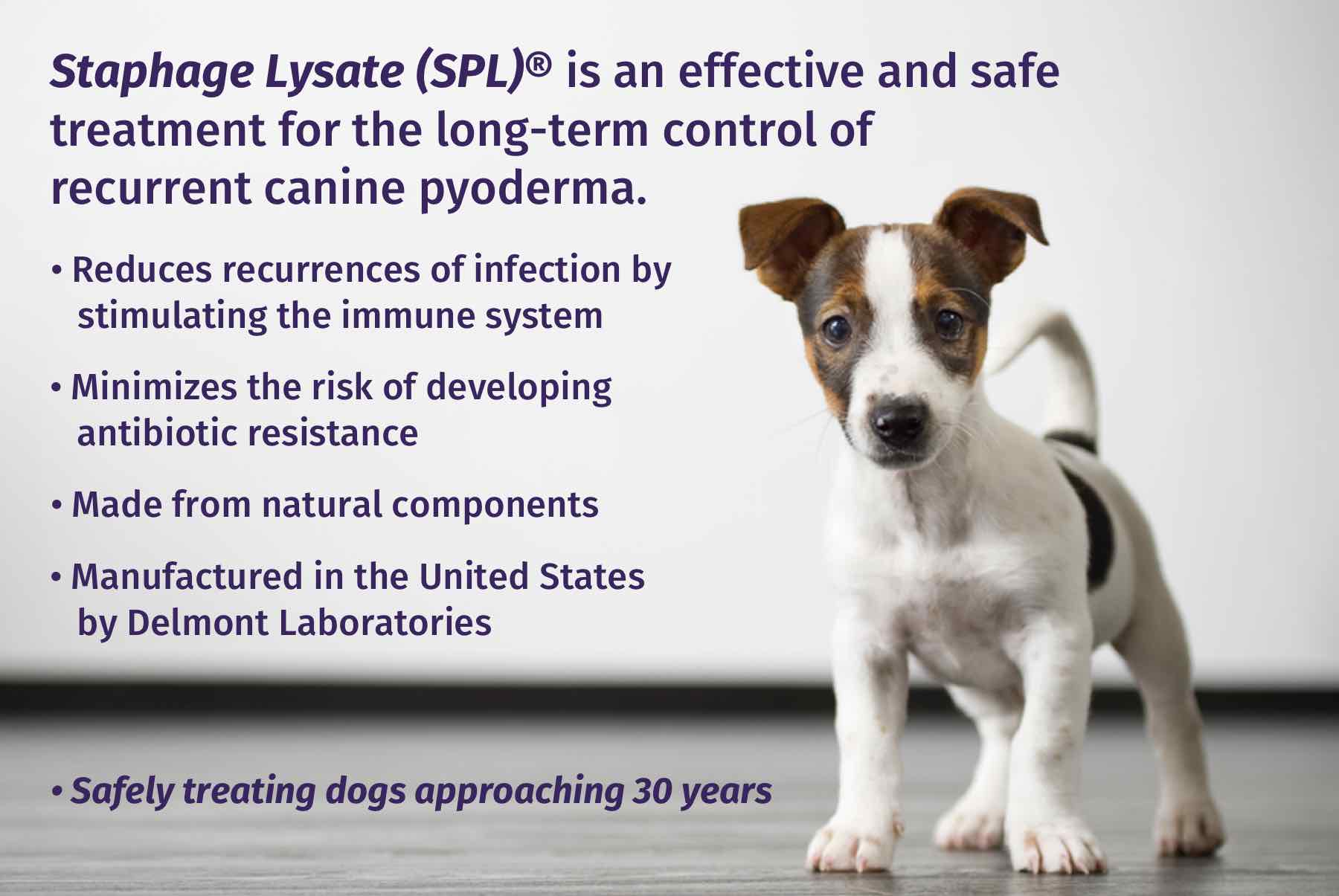
Staphage Lysate SPL® has been used effectively to desensitize dogs which are highly allergic to S. intermedius. For dogs who have skin infected with S. intermedius, i.e., recurrent pyoderma, the SPL® treatment protocol is very effective for preventing the recurrence of infection, regardless of whether they are staphylococcal hypersensitive or not.
Immunomodulation
Immunomodulators derived from natural products (microbes and plants) have been
successfully employed for more than 80 years.
Bacterial antigens, of course, have long been effectively utilized as protective immunogens (vaccines) to provide protection of the host against subsequent infections.
These immunotherapeutic products derived from bacteria have also been utilized in a broader approach as anti-infectives and anticancer agents.
The last 20 years has seen a dramatic research effort in the identification of cytokines as well as defining their role in host immune defenses against infections, inflammation and malignancy.
Not surprisingly, research on the mechanism of bacterial immunotherapeutics has demonstrated that these natural products are extremely effective in inducing the production of cytokines.
While the mechanisms of action of Staphage Lysate SPL® are currently being investigated, Delmont Laboratories' preliminary work - both in vivo2 and in vitro3 - indicates the usefulness of SPL® as an anti-tumor and anti-infective agent.
Most likely, immunocompetent cells are stimulated in vivo by SPL® to produce cytokines like TNF alpha, IFN-gamma, IL-1 beta and IL-2. Delmont Laboratories has recently demonstrated this by using in vitro assays4.
Many of the same cytokines are important for both anti-tumor effects and treatment of infective processes, as reported in a recent review article5.
Manufactured cytokines - by genetically engineered recombinant procedures - are now available for use as anti-infectives, anti-inflammatory or anti-tumor agents. These cytokines themselves can serve as immunomodulators in a number of applications.
If one considers these cytokine products for veterinary use, the following points become significant barriers:
1. Cost of the product can be significant with regard to animal application.
2. Cytokines injected into the blood stream have a limited action time. As a result, the continual need to inject the cytokines can be burdensome and often impractical.
3. Significant side effects can limit the effectiveness of cytokines, although cytokines themselves have effective roles in specifically modulating a target in the immune system.
4. The long term treatment with cytokines may result in side effects not initially apparent.
SPL® - as a natural product based immunomodulator - has several advantages in veterinary animal care:
1. It stimulates cytokines without evidence of over production of cytokines.
2. It usually does not produce unpredictable immune reactions.
3. Its mechanism of action depends upon recall immune processes to products already found in the patient's environment.
4. It has been found to be a cost effective treatment program.
More than 7,000 veterinary practices have successfully used Staphage Lysate SPL®.
Notes
1. Morales CA, Shultz KT, DeBoer DJ. Anti-staphylococcal antibodies in dogs with recurrent staphylococcal pyoderma. Vet. Immunol Immunopathol 1994; 42(2):137-47.
2. Mathur A, et. al Effect of Staphage Lysate on the growth and metastases of intradermal mammary carcinoma in a rat model. 5th International Conference on the Adjuvant Therapy of Cancer. Abstracts, Tucson, Arizona, 1987.
3. Krishnan G, Djerassi I. Activation of cancer patients' mononuclear cells by E.coli LPS and Staphage Lysate(SPL)® 7th International Congress of Immunology. Abstracts, Berlin, p 690; 1989.
4. Krishnan G, et. al. Cytokines produced by Staphage Lysate, 12th European Immunology Meeting. Abstracts, Barcelona, Spain, p 395; 1994.
5. Van Kampen, KR. Immunotherapy and Cytokines, Seminars in Veterinary Medicine and Surgery (Small Animal), Vol. 12, No. 3 (August), 1997:186-192.
Back to Top of Page
© 1997 Delmont Laboratories. Inc All Rights Reserved Staphage Lysate (SPL) and SPL are registered trademarks owned by Delmont Laboratories, Inc. Staphylococcus Aureus Phage Lysate is a USDA True Name.